Competitive Advantage
When I talk to owners about competitive advantage, I’m talking about the product a company makes or service it offers either better or more cheaply than its competitors—over time. Your company may do something differently than its competitors or it may do or make something more cheaply. In either case, differentiation or cost leadership must be paired with the ability to sustain that cost leadership or product/service differentiation over time. Michael E. Porter (a professor at the Harvard Business School) defined the concept, components, and role of competitive advantage in the operation of businesses and even nations. I will use many of Porter’s definitions as we apply them to positioning your company for success today and to selling it for top dollar in the future.
In his 2009 letter to Berkshire Hathaway’s shareholders, Warren Buffet wrote that he focuses (in good times and in bad) on four goals, the second of which is “widening the ‘moats’ around our operating businesses that give them durable and competitive advantage.” Mr. Buffet is not talking here about selling his company; he’s identifying a fundamental principle of running profitable companies today. Have you thought about the role competitive advantage plays in your company today as well as what role competitive advantage will play in its sale?
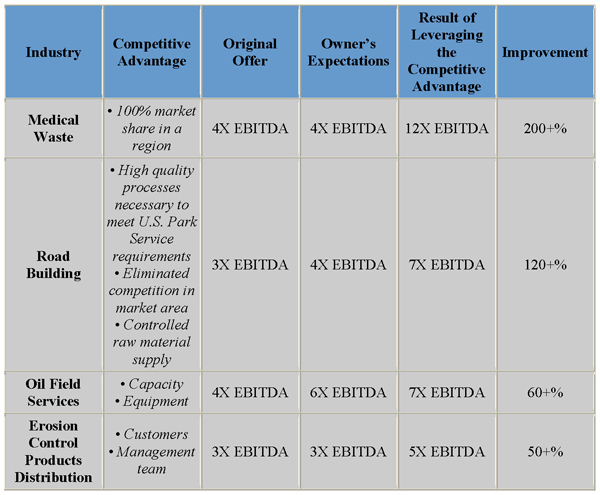
In the context of the eventual sale of a business, we’ve found that companies with a competitive advantage sell for two times the average industry multiple—what we call selling for an “outrageous” price. (See chart below for some examples of very real companies CCP has sold for outrageous prices.)
Sale-ability vs. Outrageous Price
I ask you to remember there is a difference between a company that is saleable and one that enjoys a competitive advantage. First, a company must be worth between $10M and $250M: large enough to make an impact on the buyer’s bottom line but small enough to finance with cash on hand. Second, buyers are only interested in companies with strong fundamentals such as excellent management, increasing cash flow, a diversified customer base and strong operating systems. To attract a buyer today, a company must be operating in a niche industry. Finally, to be saleable, a company must play a clear role in the buyer’s plans for growth. In our experience, only those companies meeting all four criteria are saleable in today’s market. We are happy to tell you if we think your company meets these criteria.
What difference does a competitive advantage make in a sale situation?
The short answer to this very common owner question is, “As little as twice or as much as four times the prevailing industry multiple.” This chart showing closed CCP deals more dramatically illustrates the affect competitive advantage has on sale price.
As you can see, each company’s competitive advantage is unique, but they fall into one of two categories:
cost leadership (or low cost) or differentiation.
Survey of Buyers
When I talk to business owners about competitive advantage, I ask them to remember the adage, “Beauty is in the eye of the beholder.” In this context, I remind owners that the competitive advantage they’ve worked so hard to create can be somewhat valuable, very valuable or not at all valuable—depending upon the buyer’s needs or vulnerabilities and how that advantage is leveraged.
If we uncover your company’s competitive advantage, we will identify buyers who might be willing to pay top dollar to acquire your company’s competitive advantage. Over the years, large American corporations have retained CCP to identify platforms for their future growth. By performing the necessary strategic analysis for these companies, we know what corporate buyers look for and how they value competitive advantages.
Leverage
Not only is it necessary to identify which buyer(s) will benefit most from acquiring your company’s competitive advantage, we must create a unique strategy designed to make the buyer(s) pay top dollar for your company’s competitive advantage. Strategies vary widely based on your company’s unique competitive advantage and on the specific goals and constraints of the buyers in the marketplace.
Your Role in this Process
At this point, you may have a good idea of your company’s competitive advantage.
Then again, if you are like most owners I’ve worked with, you do not. Many have a “gut” feeling
for why their customers buy from them, do everything they can to maintain or enhance that motive,
but often can’t express that motive in a sentence or even a paragraph.
Not only must you know what your company’s competitive advantage(s) is, you must understand which buyer it will attract and how to use that advantage to create pain or gain for that buyer.
We rely entirely on the accuracy and quality of the information you supply us and maintain that information in strictest confidence. The quality of our Competitive Advantage Analysis depends heavily upon your expertise, insight into your company and quality of the information you provide.
The written report we deliver to you at the conclusion of our analysis described our findings and our recommendations. Specifically, we describe your company's competitive advantage (if one exists) and our recommendations about how your company can strengthen it. We also describe our recommendations about what value that competitive advantage has in a future sale to the buyers we think might be interested in purchasing your company. Finally, we outline the strategies we might use to leverage your company's competitive advantage in a way that elicits top dollar from every interested buyer.
If we discover your company does not have a competitve advantage, we will tell you. If that is the case and you are as convinced as we are that having a competitive advantage is the key both to thriving during tough economic times and reaping maximum value for your company, as part of the analysis, we will make specific recommendations about what your company might do to create one or more competitive advantages.
I hope you give us the opportunity to help you assess your company's competitive advantage. A strategy designed to leverage your competitive advantage in a possible future sale can dramatically increase your company's sale price. That's what we do best at Clayton Capital Partners.
-Kevin M. Short
Managing Partner and CEO